Schedule 13D/G: Beneficial Ownership Reports
Overview
Schedule 13D and Schedule 13G are SEC filings required when an investor acquires beneficial ownership of 5% or more of a company's voting securities.
- Schedule 13D is filed by active investors -- those who may seek to influence or control the company (activist investors, acquirers). It requires detailed narrative disclosures about the purpose and intent of the investment.
- Schedule 13G is a shorter form filed by passive investors -- institutional investors, mutual funds, or other holders with no intent to change or influence control.
The Schedule13D and Schedule13G classes parse these XML filings into structured Python objects.
Access Pattern
from edgar import Filing

# Schedule 13D (activist investor)
filing = Filing(form="SCHEDULE 13D", ...)
schedule_13d = filing.obj()    # Returns Schedule13D

# Schedule 13G (passive investor)
filing = Filing(form="SCHEDULE 13G", ...)
schedule_13g = filing.obj()    # Returns Schedule13G
You can also search for these filings by company or across all filers:
from edgar import Company, get_filings

# Search by company
company = Company("AAPL")
filings_13d = company.get_filings(form="SCHEDULE 13D")
filings_13g = company.get_filings(form="SCHEDULE 13G")

# Or search across all recent filings
recent_13d = get_filings(form="SCHEDULE 13D").head(10)
recent_13g = get_filings(form="SCHEDULE 13G").head(10)
See it live on edgar.tools
The code above parses individual 13D/G filings. edgar.tools connects beneficial ownership data into a searchable interface — see who holds 5%+ of any company and track activist investor positions.
Also includes insider trades, 13F institutional holdings, and cross-filing linkages. Free tier available. Pricing →
Schedule 13D (Active Investors)
When you call filing.obj() on a Schedule 13D filing, edgartools parses the XML structure and displays it as a rich, formatted panel:

Top-Level Properties
| Property | Type | Description |
|---|---|---|
issuer_info |
IssuerInfo |
The company whose shares are being reported |
security_info |
SecurityInfo |
The class of securities (e.g., Common Stock) |
reporting_persons |
List[ReportingPerson] |
Beneficial owners filing the report |
items |
Schedule13DItems |
Items 1-7 narrative disclosures |
signatures |
List[Signature] |
Filing signatures |
date_of_event |
str |
Date that triggered the filing. Also available as event_date for cross-13D/13G iteration. |
previously_filed |
bool |
Whether a prior filing exists |
amendment_number |
Optional[int] |
Amendment sequence number |
is_amendment |
bool |
Whether this is an amendment (/A) |
filing_date |
date |
Date filed with the SEC |
total_shares |
int |
Aggregate beneficial ownership (handles joint/separate filers) |
total_percent |
float |
Aggregate ownership percentage |
Items (Narrative Disclosures)
Schedule 13D requires detailed narrative responses to 7 items. Item 4 (Purpose of Transaction) is the most important -- it reveals the investor's intentions.
| Property | Description |
|---|---|
item1_security_title |
Title of the security |
item1_issuer_name |
Name of the issuer |
item1_issuer_address |
Address of the issuer |
item2_filing_persons |
Identity of reporting persons |
item2_principal_occupation |
Occupation or business of filer |
item2_citizenship |
Citizenship of filer |
item3_source_of_funds |
Where the money came from |
item4_purpose_of_transaction |
Intent behind the investment |
item5_percentage_of_class |
Ownership percentage details |
item5_number_of_shares |
Share count details |
item5_transactions |
Recent transactions |
item6_contracts |
Material contracts or arrangements |
item7_exhibits |
Exhibits filed with the report |
Example: Reading a Schedule 13D
from edgar import get_filings

# Find a recent Schedule 13D filing
filing = get_filings(form="SCHEDULE 13D").head(1)[0]
schedule = filing.obj()

# The rich panel is displayed automatically when you print the object
print(schedule)

# Issuer information
print(schedule.issuer_info.name)       # "ATLANTIC INTERNATIONAL CORP."
print(schedule.issuer_info.cusip)      # "048592109"

# Ownership summary
print(f"Total shares: {schedule.total_shares:,}")   # 12,516,070
print(f"Ownership: {schedule.total_percent:.1f}%")   # 16.7%

# Reporting persons
for person in schedule.reporting_persons:
    print(f"{person.name}: {person.aggregate_amount:,} shares ({person.percent_of_class}%)")
# Output:
# Guus Paul Wilhelm Franke: 12,516,070 shares (16.66%)
# Axiom Partners GmbH: 0 shares (0.0%)

# Purpose of transaction (activist intent)
# This reveals what the investor plans to do
purpose = schedule.items.item4_purpose_of_transaction
print(purpose[:200])  # First 200 characters
# "The information set forth in or incorporated by reference in Item 3
#  and Item 6 of this Schedule 13D is hereby incorporated by reference..."
Schedule 13G (Passive Investors)
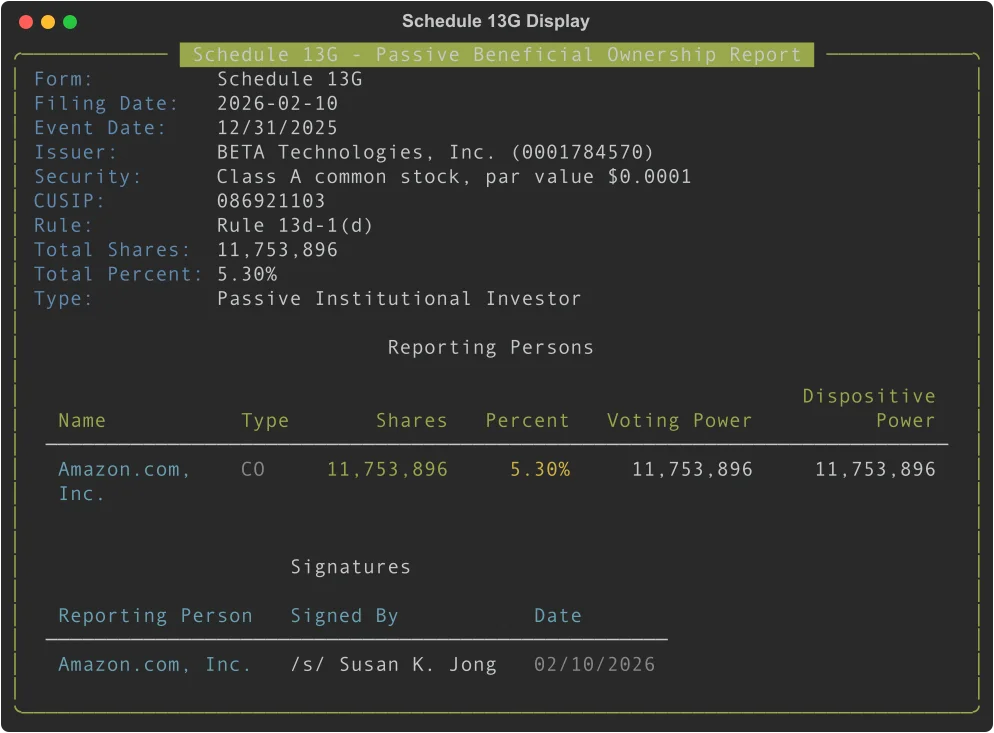
When you call filing.obj() on a Schedule 13G filing, edgartools parses the XML structure and displays it as a clean, formatted panel. Notice how it's more concise than Schedule 13D, reflecting the passive nature of the investment:
Top-Level Properties
| Property | Type | Description |
|---|---|---|
issuer_info |
IssuerInfo |
The company whose shares are being reported |
security_info |
SecurityInfo |
The class of securities |
reporting_persons |
List[ReportingPerson] |
Beneficial owners |
items |
Schedule13GItems |
Items 1-10 |
signatures |
List[Signature] |
Filing signatures |
event_date |
str |
Date that triggered the filing. Also available as date_of_event for cross-13D/13G iteration. |
rule_designation |
Optional[str] |
SEC rule under which filing is made (e.g., "Rule 13d-1(c)") |
is_amendment |
bool |
Whether this is an amendment |
filing_date |
date |
Date filed with the SEC |
total_shares |
int |
Aggregate beneficial ownership |
total_percent |
float |
Aggregate ownership percentage |
is_passive_investor |
bool |
Always True for Schedule 13G |
Example: Reading a Schedule 13G
from edgar import get_filings

# Find a recent Schedule 13G filing
filing = get_filings(form="SCHEDULE 13G").head(1)[0]
schedule = filing.obj()

# The rich panel is displayed automatically
print(schedule)

# Ownership summary
print(schedule.issuer_info.name)                    # "BETA Technologies, Inc."
print(f"Total shares: {schedule.total_shares:,}")   # 11,753,896
print(f"Ownership: {schedule.total_percent:.1f}%")  # 5.3%
print(f"Rule: {schedule.rule_designation}")         # "Rule 13d-1(d)"
print(f"Passive: {schedule.is_passive_investor}")   # True

# Reporting persons with type
for person in schedule.reporting_persons:
    print(f"{person.name} ({person.type_of_reporting_person}): "
          f"{person.aggregate_amount:,} shares")
# Output: Amazon.com, Inc. (CO): 11,753,896 shares
Practical Use Cases
Finding Activist Investors
Schedule 13D filings reveal activist campaigns. You can monitor these to track potential corporate actions:
from edgar import get_filings

# Get recent activist filings
activist_filings = get_filings(form="SCHEDULE 13D").head(20)

for filing in activist_filings:
    schedule = filing.obj()

    # Show high-ownership activist positions
    if schedule.total_percent > 10.0:
        print(f"{schedule.issuer_info.name}: {schedule.total_percent:.1f}%")

        # Check the purpose to understand their intent
        purpose_preview = schedule.items.item4_purpose_of_transaction[:200]
        print(f"  Intent: {purpose_preview}...")
        print()
Tracking Institutional Ownership
Schedule 13G filings show passive institutional holdings:
from edgar import Company

# Track who owns significant stakes in a company
company = Company("TSLA")
institutional_filings = company.get_filings(form="SCHEDULE 13G")

for filing in institutional_filings.head(10):
    schedule = filing.obj()

    for person in schedule.reporting_persons:
        print(f"{person.name}: {person.aggregate_amount:,} shares "
              f"({person.percent_of_class}%)")
Shared Data Models
ReportingPerson
Each reporting person (individual or entity) in the filing.
| Property | Type | Description |
|---|---|---|
cik |
str |
SEC Central Index Key |
name |
str |
Person or entity name |
citizenship |
str |
Citizenship or place of organization |
sole_voting_power |
int |
Shares with sole voting authority |
shared_voting_power |
int |
Shares with shared voting authority |
sole_dispositive_power |
int |
Shares with sole dispositive authority |
shared_dispositive_power |
int |
Shares with shared dispositive authority |
aggregate_amount |
int |
Total shares beneficially owned |
percent_of_class |
float |
Percentage of outstanding shares |
type_of_reporting_person |
str |
Entity type code (e.g., "IN" = individual, "IA" = investment adviser) |
member_of_group |
Optional[str] |
"a" = joint filer, "b" = separate filer |
total_voting_power |
int |
Computed: sole + shared voting power |
total_dispositive_power |
int |
Computed: sole + shared dispositive power |
IssuerInfo
The company whose securities are being reported.
| Property | Type | Description |
|---|---|---|
cik |
str |
Issuer's SEC CIK number |
name |
str |
Company name |
cusip |
str |
CUSIP identifier for the security |
address |
Optional[Address] |
Business address |
SecurityInfo
The class of securities subject to the filing.
| Property | Type | Description |
|---|---|---|
title |
str |
Security title (e.g., "Common Stock") |
cusip |
str |
CUSIP identifier |
Signature
| Property | Type | Description |
|---|---|---|
reporting_person |
str |
Name of the reporting person |
signature |
str |
Signature as signed |
title |
str |
Title of signer |
date |
str |
Date signed |
Joint vs. Separate Filers
When multiple reporting persons appear on a filing, edgartools automatically determines whether they are filing jointly (reporting the same shares) or separately (each holding distinct shares):
- Joint filers (
member_of_group = "a"):total_sharesreturns the shared amount, not a sum - Hierarchical ownership (parent-subsidiary chains): detected when percentages exceed 100%, takes the top-level amount
- Undeclared joint filers: when all persons report identical share counts, treated as joint
This means total_shares and total_percent always give you the correct aggregate, regardless of filing structure.
Tracking Amendments
Schedule 13D/G amendments (/A filings) report changes in ownership. You can compare amendments to track accumulation or liquidation:
from edgar.beneficial_ownership.amendments import OwnershipComparison

original = Schedule13D.from_filing(original_filing)
amendment = Schedule13D.from_filing(amended_filing)

comparison = OwnershipComparison(current=amendment, previous=original)

print(f"Shares changed: {comparison.shares_change:+,}")
print(f"Percent changed: {comparison.percent_change:+.1f}%")
print(f"Accumulating: {comparison.is_accumulating}")
print(f"Liquidating: {comparison.is_liquidating}")
Key Differences: Visual Comparison
Notice the differences between the two screenshots above:
Schedule 13D (Activist): - Longer, more detailed panel with narrative disclosures - Includes "Purpose of Transaction" section explaining activist intent - Shows "Source of Funds" section - Multiple reporting persons common (individual + entity) - Event date shows when the triggering event occurred
Schedule 13G (Passive): - Cleaner, shorter panel reflecting passive nature - No narrative purpose section - Shows "Rule" designation (e.g., Rule 13d-1(d)) - Often a single institutional filer - Marks filing as "Passive Institutional Investor"
13D vs. 13G: When to Use Which
| Schedule 13D | Schedule 13G | |
|---|---|---|
| Filer type | Active / activist investors | Passive institutional investors |
| Intent | May seek to influence or control | No intent to change control |
| Detail level | 7 narrative items (purpose, source of funds, etc.) | 10 mostly procedural items |
| Key field | item4_purpose_of_transaction |
rule_designation |
| Filing deadline | 10 days after crossing 5% | 45 days after calendar year-end |
| Amendment trigger | Material changes | Annual or upon crossing thresholds |
Reporting Person Type Codes
Common values for type_of_reporting_person:
| Code | Description |
|---|---|
IN |
Individual |
IA |
Investment Adviser |
BD |
Broker-Dealer |
BK |
Bank |
IC |
Investment Company |
HC |
Holding Company |
CO |
Corporation |
CP |
Co-Partnership |
PN |
Pension Fund |
OO |
Other |