Insider Trades: Track SEC Form 4 Insider Buying and Selling with Python
Know when insiders buy or sell their own company's stock. SEC Forms 3, 4, and 5 disclose every transaction by officers, directors, and major shareholders. EdgarTools parses these filings into structured Python objects with computed insights like net position change and trading plan detection.
from edgar import Company

snow = Company("SNOW")
filing = snow.get_filings(form=4).latest(1)
form4 = filing.obj()
form4
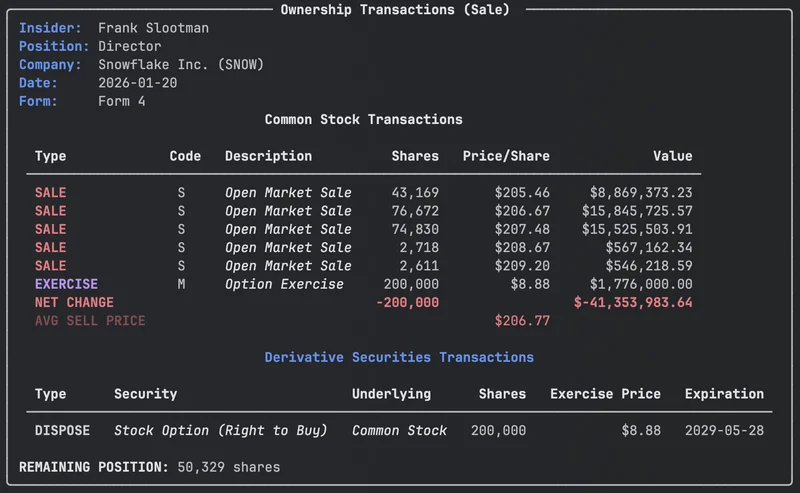
Three lines to see who traded, what they traded, and the net impact on their position.
See Snowflake's insider trading activity on edgar.tools — 186K+ filings pre-parsed →
Get the Transaction Summary
The get_ownership_summary() method returns a TransactionSummary with computed properties that answer the questions you actually care about.
summary = form4.get_ownership_summary()

summary.insider_name          # "Bruce I. Sachs"
summary.position              # "Director"
summary.primary_activity      # "Purchase", "Sale", "Option Exercise", etc.
summary.net_change            # 15000 (positive = bought, negative = sold)
summary.net_value             # 3260400.0 (net dollar value of trades)
summary.remaining_shares      # 36599
| Property | What it tells you |
|---|---|
primary_activity |
One-word categorization: Purchase, Sale, Tax Withholding, Grant/Award, Option Exercise, Mixed |
net_change |
Net shares bought minus sold -- the single most important number |
net_value |
Net dollar value of all transactions |
remaining_shares |
Insider's position after all transactions |
transaction_types |
List of unique activity types in this filing |
has_non_derivatives |
Whether any common stock was traded |
Detect Automated Trading Plans
The has_10b5_1_plan property tells you whether trades were pre-scheduled under a Rule 10b5-1 plan. This matters because pre-scheduled sales are less informative than discretionary ones.
summary.has_10b5_1_plan       # True, False, or None

# True  = trade executed under a 10b5-1 plan (automated, less signal)
# False = footnotes exist but no plan mentioned (discretionary)
# None  = no footnotes available
EdgarTools detects this by scanning transaction footnotes for 10b5-1 references -- something that would require manual XML parsing otherwise.
Access Individual Transactions
For transaction-level detail, use the filtered DataFrame properties on the Form4 object itself.
form4.market_trades              # All open-market buys and sells
form4.common_stock_purchases     # Just the buys
form4.common_stock_sales         # Just the sells
form4.shares_traded              # Total shares across all market trades
The market_trades DataFrame includes these columns:
| Column | What it is |
|---|---|
Date |
Transaction date |
Security |
Security title |
Shares |
Number of shares |
Price |
Price per share |
Remaining |
Shares owned after this transaction |
AcquiredDisposed |
"A" (acquired) or "D" (disposed) |
Code |
Transaction code (P = purchase, S = sale) |
Track Option Exercises and Derivatives
Insider filings often include option exercises, RSU conversions, and other derivative transactions.
form4.option_exercises           # Transactions with exercise code
form4.derivative_trades          # All derivative transactions
The derivative table includes exercise price, expiration date, and underlying security information.
Convert to DataFrame
The to_dataframe() method gives you full control over output format.
Detailed view (one row per transaction)
df = form4.to_dataframe()
Summary view (one row per filing)
df = form4.to_dataframe(detailed=False)
This aggregates everything into a single row with computed columns like Net Change, Net Value, Primary Activity, and per-type breakdowns (Purchase Shares, Avg Purchase Price, Sale Shares, etc.). Useful for building datasets across thousands of filings.
Strip metadata
df = form4.to_dataframe(include_metadata=False)
Removes the filing-level columns (Date, Form, Issuer, Ticker, Insider, Position) when you only need transaction data.
Initial Ownership (Form 3)
When an insider first joins a company, they file a Form 3 disclosing what they already own. EdgarTools parses these into the same object hierarchy.
filing = Company("HROW").get_filings(form=3).latest(1)
form3 = filing.obj()
summary = form3.get_ownership_summary()    # Returns InitialOwnershipSummary

summary.total_shares          # Total non-derivative shares owned
summary.has_derivatives       # True if they hold options/warrants
summary.holdings              # List of SecurityHolding objects
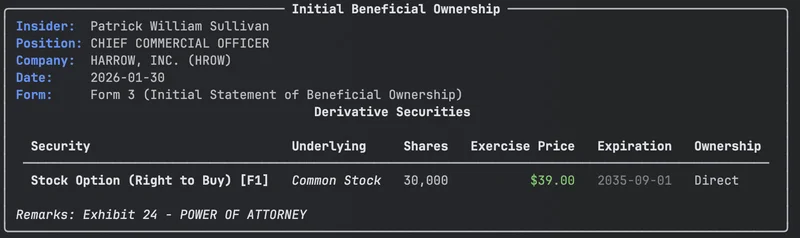
Each SecurityHolding in the list has:
| Property | What it is |
|---|---|
security_title |
Name of the security |
shares |
Number of shares or units |
direct_ownership |
True if directly owned |
ownership_description |
"Direct" or "Indirect (reason)" |
is_derivative |
Whether this is a derivative holding |
exercise_price |
Exercise price (derivatives only) |
expiration_date |
Expiration date (derivatives only) |
Look Up a Specific Insider
from edgar import Company

apple = Company("AAPL")

# All insider filings (Forms 3, 4, 5)
filings = apple.get_filings(form=[3, 4, 5])

# Just Form 4s
form4_filings = apple.get_filings(form=4)

# Latest transaction
latest = form4_filings.latest(1).obj()
print(f"{latest.insider_name} ({latest.position}): {latest.get_ownership_summary().primary_activity}")
Common Analysis Patterns
Find large purchases
from edgar import get_filings

filings = get_filings(form=4)
for f in filings[:20]:
    form4 = f.obj()
    if form4:
        summary = form4.get_ownership_summary()
        if summary.net_change > 10000:
            print(f"{summary.insider_name} bought {summary.net_change:,} shares of {summary.issuer}")
Filter out automated sales
summary = form4.get_ownership_summary()
if summary.has_10b5_1_plan is False:
    # Discretionary trade -- potentially more informative
    print(f"{summary.primary_activity}: {summary.net_change:,} shares")
Build a dataset across filings
import pandas as pd

filings = Company("AAPL").get_filings(form=4)
rows = []
for f in filings[:50]:
    form4 = f.obj()
    if form4:
        rows.append(form4.to_dataframe(detailed=False))

df = pd.concat(rows, ignore_index=True)
See this on edgar.tools
The code above parses individual Form 4 filings. edgar.tools connects 186K+ insider filings and 802K+ transactions into a searchable intelligence layer with sentiment analysis.
Includes net buy/sell sentiment, executive profiles, and cross-filing linkages to 8-K material events. Free tier available. Pricing →
Metadata Quick Reference
| Property | Returns | Example |
|---|---|---|
form |
Form type | "4" |
reporting_period |
Transaction date | "2024-01-18" |
insider_name |
Reporting insider | "Bruce I. Sachs" |
position |
Role at company | "Director" |
issuer.name |
Company name | "VERTEX PHARMACEUTICALS INC" |
issuer.ticker |
Ticker symbol | "VRTX" |
issuer.cik |
Company CIK | "875320" |
no_securities |
No securities owned | False |
remarks |
Filing remarks | "" |
shares_traded |
Total shares in market trades | 15000 |
Methods Quick Reference
| Call | Returns | What it does |
|---|---|---|
form4.get_ownership_summary() |
TransactionSummary or InitialOwnershipSummary |
Computed summary with net change, activity type, 10b5-1 detection |
form4.get_transaction_activities() |
list[TransactionActivity] |
All transactions as structured objects |
form4.to_dataframe() |
DataFrame |
Full transaction data, one row per trade |
form4.to_dataframe(detailed=False) |
DataFrame |
Single summary row with aggregated metrics |
form4.market_trades |
DataFrame |
Open-market buys and sells only |
form4.common_stock_purchases |
DataFrame |
Filtered to acquisitions |
form4.common_stock_sales |
DataFrame |
Filtered to dispositions |
form4.option_exercises |
DataFrame |
Option exercise transactions |
form4.derivative_trades |
DataHolder |
All derivative transactions |
form4.extract_form3_holdings() |
list[SecurityHolding] |
Holdings from Form 3 filings |
form4.to_html() |
str |
HTML representation |
Things to Know
Form 3 vs 4 vs 5. Form 3 is initial ownership (when someone becomes an insider). Form 4 is changes (buys, sells, grants). Form 5 is an annual catch-up for anything not reported on Form 4. Most analysis focuses on Form 4.
Transaction codes. P = open-market purchase, S = open-market sale, M = option exercise, A = grant/award, F = tax withholding, G = gift, C = conversion. The primary_activity property translates these for you.
Footnotes contain critical context. Prices, share counts, and 10b5-1 plan disclosures often live in footnotes, not the transaction table. EdgarTools resolves footnote references automatically.
Derivative transactions are complex. Option exercises often pair with a same-day sale. The derivative_trades property keeps these separate from common stock transactions.
Amended filings (3/A, 4/A, 5/A). EdgarTools handles amendments transparently -- they parse identically to the original form types.
Related
- Track Company Insiders -- monitor insider activity for a specific company
- Working with Filings -- general filing access patterns